
Friday, 16 November 2012
Focus
This is a link to one of my favourite magazines, it deals with technology and science,which includes psychology, it comes out once a month. It has some really interesting stuff in it.


Purchasing a new Laptop

Buying a Laptop for Applied Psychology in IADT
In my opinion the most important thing to look at when purchasing a new laptop is battery life, if a laptop can’t last as long as your college day without being recharged you can run into a lot of problems. Anything under four hours isn’t really ideal, the bigger number of battery cell the longer the battery life but as a student on the go it is important to consider the size and weight a large number battery cell can have, so it’s best to meet somewhere in the middle of comfort and battery life. Personally I would suggest somewhere around a 9 cell pack.
Screen size has to be considered too, a small screen size makes a laptop easier to move around, however in our course Photoshop plays a big part in one of the modules so a small screen size can make it difficult to see the detail, for this I feel a 17-inch display works quite well.
The Specs;
Cost is another important factor, when buying a laptop it’s about balancing the required specs and the price. For a student I feel the price range is between 400 and 800 euro. There is nothing wrong with paying under this price range but just make sure it has all the requirements.
Other factors to be considered when buying a laptop are; do you like the way the keyboard feels and are you able to easily operate the touch pad. Also does the Laptop come with an option for a warranty.
Any laptop meeting these requirements should be perfect for this course.
- For a CPU I find that the Intel Pentium T4500 should suit most college student’s needs, it’s perfectly suited for Internet, streaming videos and casual gaming.
- A minimum RAM of 3GB is a must in any modern laptop, so much so it’s hard to actually find a new laptop with less. In any case 3GB of RAM should meet most needs but just to be sure if the option is there opt for 4GB.
- When it comes to a Hard Drive speed is more important than size, the higher the rpm the faster the hard drive, I would recommend a 7200RPM drive with 320GB. If more memory is required an external hard drive can easily be purchased at around one hundred euro for 1TB.
- The integrated graphics chip in any laptop should be fine for the user’s needs.
- A disk drive is becoming obsolete with most content such as games, music and movies being available to download online or stream.
Cost is another important factor, when buying a laptop it’s about balancing the required specs and the price. For a student I feel the price range is between 400 and 800 euro. There is nothing wrong with paying under this price range but just make sure it has all the requirements.
Other factors to be considered when buying a laptop are; do you like the way the keyboard feels and are you able to easily operate the touch pad. Also does the Laptop come with an option for a warranty.
Any laptop meeting these requirements should be perfect for this course.
Femto Photography
Recently while using one of my favourite sites StumbleUpon I came across an article on Femto photography, this is a new kind of technology that allows the user to see an image at a trillion frames per second, which sounds kind of cool but what use does it have and what does that really mean? Upon further research on femto photography I learned that this means that slow motion videos of light in motion or light propagation can be created, which according to the second article means the technology could be used to see around corners or look into the human body without exposing it to an x-ray. The articles didn't go into much detail on looking into the human body but focused more on looking around corners. Below is a video that explains how this idea works.
Essentially what the video tells us is that by firing a laser pulse at a corner and using the femto photography to record it an image of what lies around the corner can be reconstructed. The femto technology records the light protons that are released when the laser hits the corner and using these protons in a similar way to radar a computer can generate a basic image of the hidden object.
Although at the moment this use of the technology is quite basic Ramesh Raskar, the brain behind femto photography, says that in the future this could be used in cars to avoid collisions around dangerous corners or by rescue workers at fires or earthquakes to locate survivors. The technology if worked on could also hold great importance in medical technology for health imaging.

Essentially what the video tells us is that by firing a laser pulse at a corner and using the femto photography to record it an image of what lies around the corner can be reconstructed. The femto technology records the light protons that are released when the laser hits the corner and using these protons in a similar way to radar a computer can generate a basic image of the hidden object.
Although at the moment this use of the technology is quite basic Ramesh Raskar, the brain behind femto photography, says that in the future this could be used in cars to avoid collisions around dangerous corners or by rescue workers at fires or earthquakes to locate survivors. The technology if worked on could also hold great importance in medical technology for health imaging.
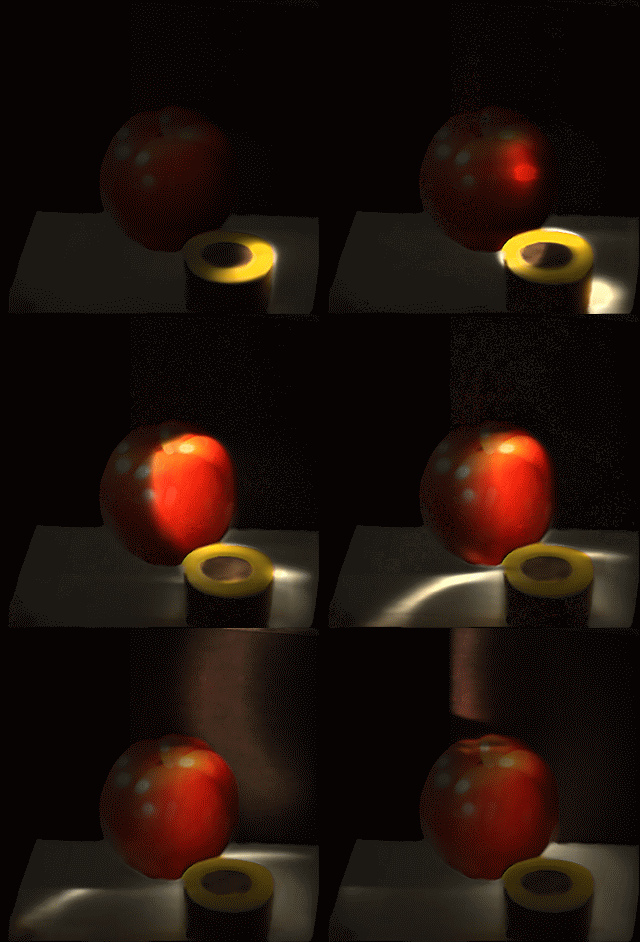
The thing that has to be considered is that currently Femto photography is at its most basic level and Ramesh Raskar ideas of its uses in the future can only be realised if additional researchers investigate and apply this technology in their own way, as usually happens with new technology some of its most interesting uses probably haven't even been thought of yet. I suppose this is the very reason I am interested by this technology, the fact that it is only in its beginnings and could become an important technology in the future or it due to lack of interest by investors or the scientific community it could simply disappear.
Here is Ramesh Raskar's TED talk on femto photography.
The city of the future.
The city of
the future is being built today using today’s technology, Masdar city if
completed will be the world’s first zero Co2 emission and self-sufficient energy
city. Below are links to more information on the city and concept
images of the city.


Useful links..
For my first
proper post here are some links to interesting psychology sites that are
helpful to students for exploring different areas.
The first
link is to Psyblog, a blog that posts and reflects on psychological studies
from various academic journals. http://www.spring.org.uk/
The second
link is to the British Psychological Society's Research Digest blog, which provides
reports on the latest psychology research papers. The blog contains a good mix
of serious and fun psychology research papers. http://bps-research-digest.blogspot.ie/
The final
link is to the Psychology Today website, it contains articles in all areas of
psychology, written to be read by not just psychologists but anyone with an
interest in the subject.http://www.psychologytoday.com/
The
important thing and the main reason I chose these websites was due to the fact
that they are all easy to read sites on psychology making them much more
enjoyable than working through a scientific journal.
Hey!
Hi I'm Evan,
I am eighteen and I'm in my first year of Applied Psychology in IADT. I'm starting this blog as part of an assignment for my ICT class. Much like my
course in IADT this blog will be a mix of psychology, technology and media, however
initially it will probably have more of a focus on the technology aspect as it
is part of my ICT assignment. I hope that after completing my assignment I will
continue to update this blog with a mixture of technology and psychology
articles and videos.
Subscribe to:
Posts (Atom)